







Software Subscriptions in Industrial Environments
Business Model, Production Reality, and Technical Enforcement
Subscription models are well established across the software industry. In SaaS environments, they have effectively become standard. In industrial environments, however, the situation is more nuanced. While certain engineering software solutions have transitioned to subscription models, perpetual licenses with maintenance agreements continue to dominate machine-level or production-critical systems.
The primary reason is not the business model itself, but the technical and organizational framework of industrial IT. Production environments are often offline, safety-critical, and designed for maximum availability. In these settings, subscriptions must not introduce additional operational risk.
The key question, therefore, is not whether subscriptions make sense, but how they are deployed and maintained.
Why Should Vendors Offer Subscriptions?
From a vendor’s perspective, there are clear strategic arguments in favor of subscription models.
Predictable, Recurring Revenue
Recurring revenue stabilizes cash flow, improves forecasting reliability, and positively impacts company valuation. Revenue is distributed more evenly over time, reducing dependence on large one-time projects.
Higher Customer Lifetime Value
Instead of a single transactional license sale, subscriptions create an ongoing business relationship. Extensions, feature packages, and additional services can be systematically integrated.
Lower Barriers to Entry for Customers
Spreading costs over time reduces upfront investment hurdles and accelerates purchasing decisions, especially for modular or feature-based products.
Monetization of Services and Features
Predictive maintenance, analytics functions, remote support, or AI-driven enhancements are difficult to structure as one-time licenses. Subscriptions provide a flexible monetization framework for such offerings.
Risks and Challenges for Vendors
Transitioning to subscriptions involves structural changes.
Revenue Shift During the Transformation Phase
When moving from perpetual licenses to subscriptions, revenue timing shifts. This requires financial planning and clear communication with investors and stakeholders.
More Complex System Integration
ERP systems, CRM platforms, billing processes, and license management must work consistently together. A subscription is not an isolated licensing model, but an integrated business process.
Offline Reality in Industrial Environments
Production systems are often not permanently online. A subscription model must therefore avoid hard dependency on continuous cloud connectivity.
Advantages and Disadvantages for Users
For industrial customers, operational reliability and predictability typically matter more than financial metrics.
Reduced Upfront Investment
Instead of large one-time payments, costs are distributed over the subscription term. This lowers investment risk and facilitates budget approvals.
Predictable Operating Expenses (OPEX)
Subscriptions create a consistent cost structure and can be fully expensed within the operating year.
Continuous Development
Updates, security patches, and new features are typically included. This reduces version fragmentation and simplifies support processes.
Long-Term Total Cost
Over multiple years, a subscription may exceed the cost of a perpetual license. A transparent Total Cost of Ownership analysis is essential.
Vendor Dependency
Subscriptions increase reliance on the provider – a strategic consideration in products with long life cycles.
Transparency of Renewal Logic
Unclear renewal mechanisms or automatic renewals without transparent communication can quickly lead to acceptance issues.
Technical Dependency on Licensing Infrastructure
Malfunctions during renewal or synchronization can have production-critical consequences.
Industrial systems are often:
- Air-gapped
- Only sporadically online
- Configured with strict security controls
Subscriptions will only be accepted if they function reliably and predictably even under offline conditions.
Processes: Organizational Control of Subscriptions
In industrial contexts, a subscription is first and foremost a business process. The central question is: Which system manages the contract status? With CodeMeter License Central and CodeMeter License Portal, multiple architectures are possible.
ERP System as the Leading System
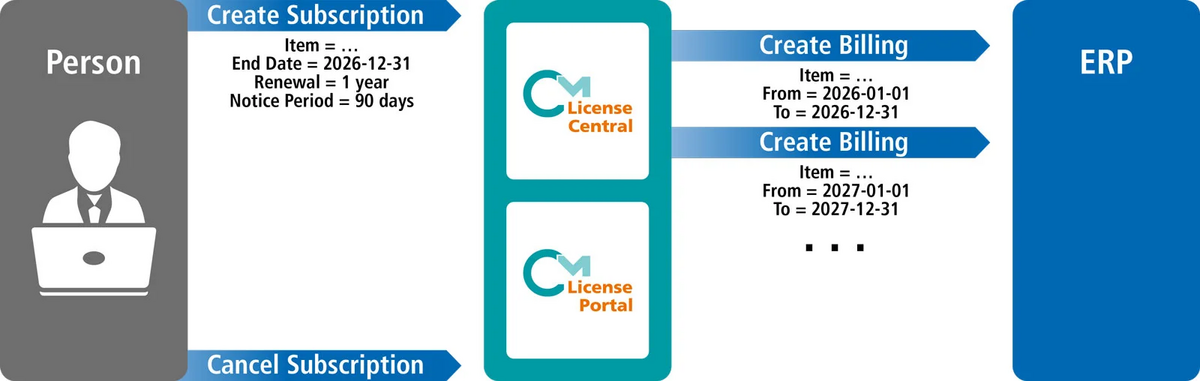
The ERP system manages subscription terms, cancellation periods, and contract status.
When a subscription is created, the ERP system transfers the relevant term parameters to CodeMeter License Portal. The Portal generates a time-limited license with the corresponding expiration date.
At each renewal, the ERP system sends updated information to CodeMeter License Portal. The Portal adjusts the license term and provides the update to the user.
The ERP system remains commercially authoritative, while the Portal handles technical implementation.

Asynchronous Control
The ERP system defines the start date, term, and renewal interval.
The initial process is identical to the “ERP system as the leading system” model: when a subscription is created, the ERP system transmits the relevant term parameters to CodeMeter License Portal. CodeMeter License Portal then generates a time-limited license with the same expiration date.
In contrast to the “ERP system as the leading system” model, however, CodeMeter License Portal renews the subscription automatically and asynchronously and provides the update to the user. Automatic renewal continues until the ERP system transmits a cancellation of the subscription.
Additionally, CodeMeter License Portal can notify the ERP system of the automatic renewal if this information is required for billing within the ERP system.
Management Within CodeMeter License Portal
Alternatively, CodeMeter License Portal itself can act as the leading system. Start and end dates are managed there. The ERP system periodically receives billing data and is responsible only for invoicing. Online payment providers can also be integrated directly with CodeMeter License Portal, with the ERP system optionally receiving the data for informational purposes.
This approach decouples contract logic from ERP system complexity. It is particularly relevant in industrial environments where ERP systems are designed primarily for one-time hardware sales. Modifying ERP systems often involves long implementation timelines and significant cost, making subscription management within CodeMeter License Portal an attractive alternative.
Time Quotas
Strictly speaking, time quotas are not subscriptions. They are prepaid models in which the user purchases a defined time package. Once expired, a new quota is purchased and activated.
This model is frequently used to simplify initial onboarding, with the option to transition into a full subscription model while crediting any remaining time.
Technical Enforcement: Enforcing the Subscription Term
While the previous section addressed organizational aspects, this section focuses on technical implementation.
Technically, a subscription is implemented as a time-limited license. Licenses within the license container are assigned individual expiration dates. Activation follows the same process as a traditional license. The user receives a ticket and activates it on the target system. In online scenarios, this occurs with a single click via a Software Activation Wizard that uses the License Portal API.
In offline scenarios, a context file is generated from the target container. This file contains a fingerprint and the licenses already present. Using this context file and the ticket, activation is performed on an online system within CodeMeter License Portal. The resulting update file is transferred to the offline system and imported into the target container. Optionally, a receipt file can be generated and uploaded to CodeMeter License Portal.
Upon renewal, the expiration date is updated. CodeMeter License Portal recognizes the target container and generates the appropriate update file accordingly. In online scenarios, the Software Activation Wizard automatically downloads and applies the update in the background. In offline scenarios, the user downloads the file from CodeMeter License Portal and transfers it manually to the offline computer.
An optional approach is to preload a base license during production onto a newly manufactured device. This creates the license container and eliminates the need to generate a context file on the target system during initial activation.
Even during operation, transmitting a new context file can be beneficial. A new context file confirms that updates have been received and reduces the size of subsequent update files. If a subscription needs to be transferred to another device, the software vendor determines whether a receipt-based confirmation from the original device is required, or whether limited self-service transfer without receipt is permitted.
Internal Subscriptions
Subscriptions are often associated with monetary transactions, but this is not necessarily the case. There are internal scenarios in which subscription-like mechanisms are useful.
Licenses used by employees and sales partners for demonstrations are often structured as subscriptions. If a license is lost, renewal can simply be discontinued. In some cases, renewal periods are intentionally shorter than for customer subscriptions.
Subscriptions are also valuable for test licenses within development or QA departments. Terms can be configured in minutes or hours to ensure sufficient licensing during testing, while also enabling validation of expired-license scenarios.
Subscriptions can function effectively in industrial environments when implemented, as with CodeMeter, to reliably support offline scenarios above all else.
KEYnote 51 – Edition Spring/Summer 2026