







Wibu-Systems Strengthens Supervisory Board with Renowned Cryptography Expert Prof. Dr. Joern Mueller-Quade
- Prof. Dr. Joern Mueller-Quade, one of Germany’s leading experts in cryptography and IT security, joins the Supervisory Board of WIBU-SYSTEMS AG
- Research focus includes secure cloud computing, secure multi-party computation, formal security models, and hardware trust anchors
- Appointment builds on years of close collaboration in research, technology evaluation, and strategic dialogue
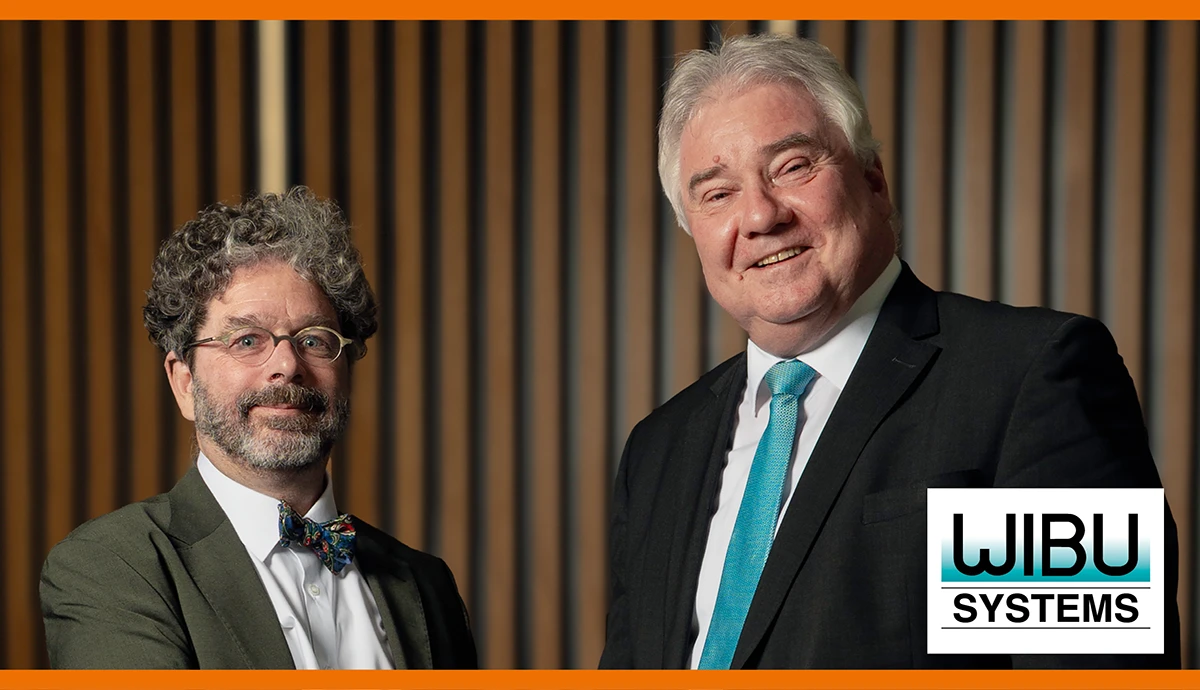
Oliver Winzenried and Prof. Dr. Joern Mueller-Quade during a joint discussion at Wibu-Systems’ premises in Karlsruhe.
WIBU-SYSTEMS AG, a global leader in software protection, licensing, and cybersecurity for digital assets, has appointed Prof. Dr. Joern Mueller-Quade to its Supervisory Board, further strengthening the company’s strategic oversight in the fields of cryptography, secure computing, and long-term digital resilience. The decision reflects a collaboration that has matured over several years and is rooted in a shared commitment to security architectures that are both scientifically rigorous and operationally viable.
Prof. Dr. Mueller-Quade is internationally recognized for his work in cryptography and IT security. His research spans secure cloud computing, secure multi-party computation, formal security definitions and models, and hardware-based trust anchors – disciplines that are increasingly central to protecting software-defined systems, intellectual property, and digital infrastructures in regulated and adversarial environments.
Since 2008, Prof. Dr. Mueller-Quade has held leading academic positions in IT security at what is now the Karlsruhe Institute of Technology (KIT). He is responsible for Cryptography and IT Security at KASTEL, the Institute of Information Security and Dependability, one of Germany’s leading interdisciplinary security research institutes. At KASTEL, his work focuses on long-term security, cryptographic foundations, and the dependable design of complex digital systems, bridging formal security models with applied, system-level protection concepts that are directly relevant to industrial and critical-infrastructure environments.
The professional relationship between Wibu-Systems and Prof. Dr. Mueller-Quade dates back many years and includes close collaboration on software protection concepts, hardware-supported security models, and forward-looking security strategies. He was involved early in the scientific evaluation of Wibu-Systems’ patented Blurry Box technology, which won the first prize at the German IT Security Awards in 2014, participated in expert discussions on quantum computing and digital sovereignty, and joined the INNO DAYS 2025 roundtable on building secure and independent IT infrastructures.
“Security that endures cannot be improvised. It requires sound models, resilient architectures, and a deep understanding of how theory translates into systems that withstand real-world attacks,” said Oliver Winzenried, CEO and founder of Wibu-Systems. “Our long-standing collaboration with Prof. Dr. Mueller-Quade has consistently reinforced this conviction. His appointment to the Supervisory Board is a logical step and a strong signal of our commitment to research-backed, long-term security, especially as cryptography, software protection, and licensing face profound change driven by quantum computing and regulation.”
From Prof. Dr. Mueller-Quade’s perspective, the appointment reflects a rare alignment between academic research and industrial execution:
“Wibu-Systems has always distinguished itself by rejecting security through obscurity in favor of transparent, well-founded protection concepts,” said Prof. Dr. Joern Mueller-Quade. “The company translates cryptographic principles, hardware trust anchors, and licensing mechanisms into deployable technologies with measurable security value. I look forward to contributing my experience to the strategic development of these approaches as digital systems grow more complex and more exposed.”
With Prof. Dr. Mueller-Quade joining the Supervisory Board, Wibu-Systems reinforces its focus on secure-by-design architectures, cryptographic agility, and long-term protection of digital assets, from embedded and industrial software to cloud-based and hybrid deployment models. His expertise will support the company in navigating emerging challenges such as post-quantum security, sovereign IT infrastructures, and evolving regulatory requirements.